
The Fog That Won’t Lift
You know the feeling.
You wake up after a full night’s sleep, but your brain feels like it’s wrapped in cotton wool. Simple decisions—what to eat for breakfast, which email to answer first—feel overwhelming. You stare at your to-do list, but the motivation to start anything just isn’t there.
This isn’t physical tiredness. This is mental exhaustion.
And no amount of coffee, naps, or “just pushing through” will fix it.
If this sounds familiar, you’re not broken. You’re not lazy. You’re simply running on an empty emotional battery—and it’s time to recharge the right way.
What Is Mental Exhaustion? (And Why It’s Different)
Mental exhaustion happens when your brain has been processing too much for too long without enough recovery time.
Think of it like this:
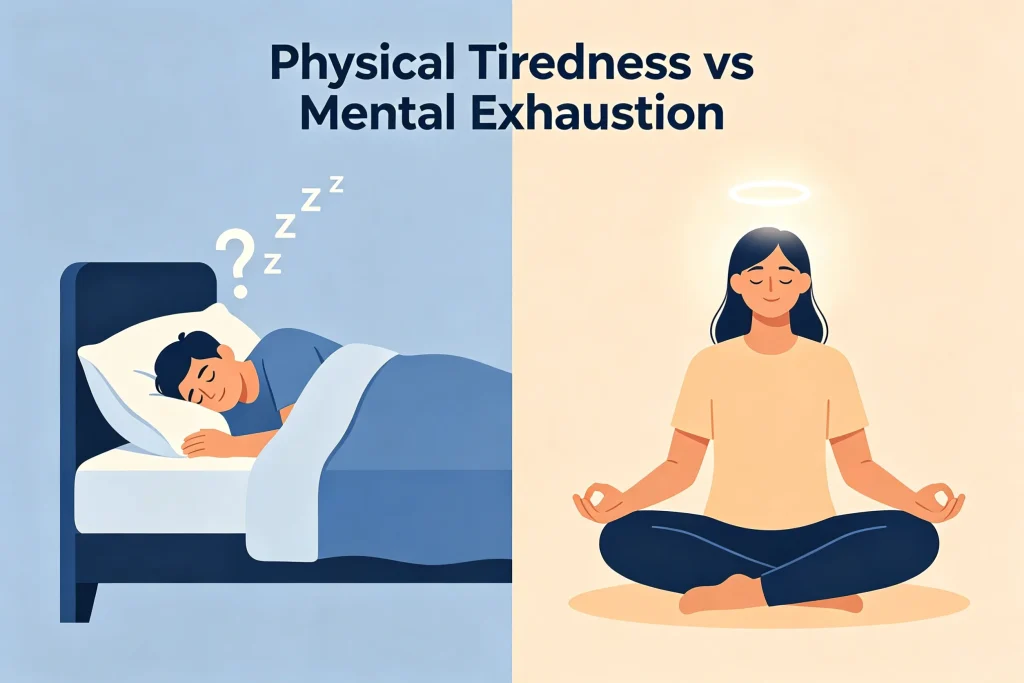
| Physical Tiredness | Mental Exhaustion |
|---|---|
| Your body needs rest | Your mind needs stillness |
| Sleep usually helps | Sleep alone doesn’t fix it |
| You feel heavy, slow | You feel foggy, numb, or irritable |
| Caused by physical activity | Caused by stress, overthinking, decisions, emotions |
Mental exhaustion creeps up slowly. It’s the result of weeks or months of:
- Constant worrying
- Overthinking every conversation
- Making endless small decisions
- Suppressing emotions
- People-pleasing at your own expense
- Information overload (social media, news, notifications)
By the time you notice it, you’re already deep in the fog.
7 Signs You’re Mentally Exhausted (Not Just Tired)
Not sure if this is you? Check these signs:
1. You feel indifferent or numb
Things that used to make you happy now feel flat. You don’t feel sad—you just don’t feel much at all.
2. You’re easily irritated
Small things—a notification sound, someone asking a question, a misplaced item—trigger disproportionate frustration.
3. You can’t focus
Reading the same paragraph three times. Forgetting what you walked into a room for. Losing your train of thought mid-sentence.
4. You procrastinate constantly
Even tasks you want to do feel like a mountain. You scroll instead of start.
5. You feel detached from others
You withdraw from conversations. You’re physically present but mentally checked out.
6. Your sleep is restless
You fall asleep fine, but you wake up multiple times—or wake up feeling like you never slept at all.
7. You’ve lost motivation
Goals that excited you now feel meaningless. You’re going through the motions without direction.
If you checked 3 or more of these, your mental battery is critically low.
What Causes Mental Exhaustion? (Beyond the Obvious)
Yes, work stress and life challenges play a role. But often, the deeper causes are things you might not recognize:
The Decision Fatigue Trap
Every choice you make—what to wear, what to eat, which task to start first—uses mental energy. By late afternoon, your brain’s decision-making capacity is depleted. That’s why small choices feel impossible.
Emotional Labor
If you’re constantly managing other people’s feelings, staying “nice” when you’re frustrated, or hiding your true emotions—that’s exhausting. Suppressing feelings takes massive energy.
Ruminating (The Endless Thought Loop)
Your brain gets stuck replaying the same conversation, worry, or regret over and over. This isn’t problem-solving. It’s mental quicksand—and it drains you faster than anything else.
Overstimulation
Notifications. Background noise. Screens. Crowded spaces. Your brain is processing thousands of inputs every hour. It’s not designed for this. The constant noise creates mental static that never clears.
How to Recover from Mental Exhaustion (Practical Steps)
Recovery isn’t about doing more. It’s about doing less—and doing it intentionally.
Step 1: Create Mental White Space
Action: Block 10 minutes this morning with no input. No phone. No music. No talking. Just sit.
This feels uncomfortable at first because your brain is addicted to stimulation. That discomfort is exactly why you need it.
Crystal Support: Selenite
Selenite is known for mental clarity and clearing energetic fog. Place a Selenite wand on your desk or hold it during your 10 minutes of silence. It helps quiet the internal chatter.
Step 2: Stop Replaying—Start Releasing
Action: Write down one thought that’s been looping in your head. Then literally tear the paper up or burn it (safely). The physical act of destruction signals your brain: This thought is done.
Crystal Support: Smoky Quartz
Smoky Quartz absorbs and transmutes negative energy—including mental rumination. Keep a piece in your pocket. When you notice a thought loop starting, touch the stone and take three deep breaths.
Step 3: Reduce Decisions (Seriously)
Action: Eliminate 3 small decisions from your day this week.
- Eat the same breakfast every day
- Wear a “uniform” (same style, different colors)
- Schedule recurring tasks at the same time
Each decision you remove preserves mental energy for what actually matters.
Crystal Support: Clear Quartz
Clear Quartz amplifies clarity and focus. Place it near where you do your daily planning. It helps you see what’s essential vs. what’s just noise.
Step 4: One Emotion at a Time
Action: Set a timer for 5 minutes. Name the emotion you’re feeling (just one). Say it out loud: “I feel overwhelmed.” Or “I feel anxious.” Or “I feel empty.”
That’s it. No fixing. No judging. Just naming.
Naming an emotion reduces its power over you. It moves the feeling from your subconscious (where it drains you) to your conscious mind (where you can address it).
Crystal Support: Lepidolite
Lepidolite contains natural lithium, a known mood stabilizer. It’s exceptional for emotional overwhelm and mental exhaustion. Hold it while you name your emotion.
Step 5: Stop Trying to Be Productive
Action: Take one full evening this week with zero expectations. No goals. No “I should.” No self-improvement. Just exist. Watch a familiar movie. Stare out the window. Lie on the floor.
Rest without purpose is the purpose.
Crystal Support: Amethyst
Amethyst transforms stress into tranquility. Place an Amethyst cluster in your living space as a visual reminder: Rest is allowed.
When Mental Exhaustion Won’t Go Away
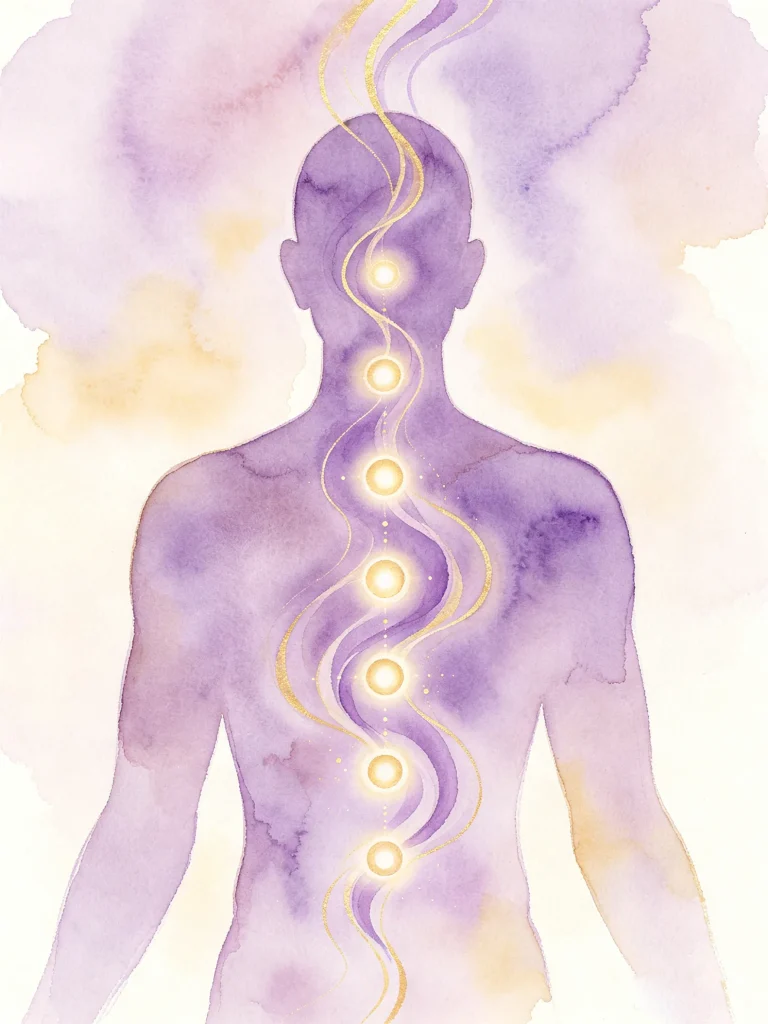
Sometimes, what looks like mental exhaustion is actually an energy imbalance in your upper chakras.
- Third Eye Chakra (between eyebrows): When blocked, you feel foggy, indecisive, and disconnected from intuition.
- Crown Chakra (top of head): When blocked, you feel lost, unmotivated, and disconnected from purpose.
If the practical steps above help but don’t fully resolve your mental fog, consider working with these chakras directly.
For Third Eye: Lapis Lazuli or Amethyst
For Crown: Clear Quartz or Selenite
Place the stone on the corresponding chakra point for 10-15 minutes while lying down and breathing slowly.
Tonight’s Reset Ritual
Before bed tonight, try this 6-minute ritual:
- Minute 1-2: Hold Smoky Quartz in your left hand. Breathe in slowly. Exhale like you’re sighing out the fog.
- Minute 3-4: Switch to Lepidolite. Say out loud: “I release what my mind no longer needs to carry.”
- Minute 5-6: Place Amethyst on your nightstand. Lie down and put one hand on your forehead. No thinking. Just feeling your breath.
Then sleep. Without expectation. Without guilt.
The Truth About Mental Exhaustion
Here’s what no one tells you:
Mental exhaustion isn’t a sign of weakness. It’s a sign that you’ve been strong for too long without a break.
Your brain isn’t broken. It’s just tired.
And like any tired thing, it doesn’t need fixing. It needs rest. It needs stillness. It needs permission to stop performing and just be.
You’re not behind. You’re not failing. You’re human.
And humans need recovery.
Your Energy Deserves Protection
You wouldn’t leave your phone on 2% battery and expect it to run apps all day.
So stop doing that to yourself.
Start small. One silent minute. One released thought. One less decision. One emotion named.
And let the crystals hold space for the rest.
Ready to support your mental recovery?
[Shop the Mental Clarity Collection]
Featuring Selenite, Smoky Quartz, Lepidolite, and Amethyst—hand-selected for mental exhaustion and emotional renewal.